Dangers of New Years Resolutions

By Lissa Carter, LCMHCS
Whether or not you belong to a tradition that honors the first of January as the beginning of a new cycle, the energy given to personal change this time of year is palpable. The parking lot of the gym I pass on the way to the office has been crammed with cars since the 1st, and conversations with friends and clients revolve around reviewing the year past and naming hopes for the year ahead.
The invitation to reflect on our actions and intentions is welcome. And yet, the pitfalls inherent in the way we approach resolutions can undermine our hopes and plans. Here are three dangers I’ve noticed in New Year’s resolutions, and three filters that help to combat them.
First danger: Setting Goals that are Subtractive
Brains are additive, not subtractive. Let me offer an example: while looking for a stud finder at the hardware store this morning, I located a brand called “StudBuddy” (everyone, this is not a Freudian blog. StudBuddy is a device that locates two-by-fours beneath sheetrock) and for the rest of the morning found myself whistling the jingle for arguably creepy 80’s toy “MyBuddy”.

My brain never erased that jingle –it’s still there, all these years later. I could write new lyrics—“Stud buddy! Stud buddy! When it beeps that’s where the na-ai-ail goes!”—and remember them too—but, given a relatively normal developmental arc, my brain will not erase the original jingle. It’s there for keeps.
Which is some of the reasoning behind why, when setting intentions and objectives, it’s advisable to avoid “Dead Man Goals”, which are anything a dead man could do better than you. For example: be calmer with my children, argue less with my partner, eat less sugar, drink less alcohol. That metaphorical dead man would clean the floor with me on any one of them.
Each one of these goals requires me to subtract something to achieve success. And much to my dismay, even if the reward were free tickets to Ireland to attend a sacred storytelling festival, I would not be able to erase the &%@#!% “MyBuddy” jingle from my brain.
You can avoid this pitfall by setting intentions that are additive, not subtractive. For example: I’d like to start more of my mornings with a walk outside. Or, I’d like to read a chapter of an inspiring book every week.
Second danger: Framing Intentions Around Self-Improvement
Let me hasten to say, there is nothing wrong with noticing behaviors or attitudes that are harmful to you, your relationships, or your communities and working to make more values-congruent choices.
Programs of discipline and improvement do work. They work to change behavior. And they work to change behavior, usually, at the cost of the relationship.
How do you feel about someone who is trying to discipline you? To improve you? Even if you agree with their longterm ideas, the act of being disciplined or targeted for improvement tends to erode that relationship. This can be fine when the relationship is short-term or narrow, and specifically chosen to create improvement, such as with a coach or a supervisor.
But when the relationship is with your very self—the one person you will never be able to retreat from—the cost-benefit ratio of eroding relationship to improve performance becomes incredibly steep. Quality of life tanks when the person closest to you is more concerned with improving you than with relating to you. And when quality of life is low, it is difficult to muster the kind of energy and focus necessary to carry out self-improvement projects anyway!

Instead of self-improvement and self-discipline, I would propose self-attunement.
Self-attunement resembles a loving parent-child relationship. A loving parent isn’t going to allow a child to run into traffic or hit another child. But neither are they going to bully their child, or call them names. A parent who is truly attuned to their child will be both kind and firm, neither accepting inappropriate behaviors nor endangering the relationship to enforce discipline.
In a situation of attunement two things happen: one, strong emotions and incongruent behaviors are immediately de-escalated due to co-regulation with a calm, loving person. And two, the feeling of being understood and accompanied makes the situation that triggered those strong emotions and incongruent behaviors feels more bearable, making a little room to consider other options for response.
Often, counterintuitively, it is the relationships where we feel accepted—as Carl Rogers said—exactly as we are, within which we can achieve lasting change. And regardless of the kind of parenting we actually received as children, every one of us is capable of creating attunement with ourselves. It’s the difference between telling yourself what to do, and checking in with yourself kindly to see what you might need in order to be able to accomplish the things that matter to you.
Third danger: Framing Intentions Around Comparison
We humans have an innate bias, when resources are scarce, to form “in” groups and “out” groups. We exclude and dehumanize those who seem different than ourselves. It’s heartbreaking to witness the immensity of suffering caused by this tendency to dehumanize others. And although it is easy to see it on the scale of war, it’s harder to notice it within our own minds. One subtle way this bias appears is through a lens of comparison.
If I say, for example, that I want to be “as successful as Y” or “as strong as X”, underlying both of these intentions is the subtle belief that Y and X are separate from me. Viewed through this lens, the world is a dangerous, competitive place where the resources I need can be snapped up by others.
But viewed through a more ecologically accurate lens of interdependence, I could notice that Y’s success and X’s strength are resources in a community that nourishes me, as well—and that my support of X and Y would ultimately benefit me, too.
By setting intentions that are collaborative rather than competitive we can begin to build the muscle of seeing the world interdependently. In this way we can shift “I want to be stronger than X” to “I want to build strength so that I can be more active in my community and a resource for my grandchildren.” Caring for the trees around you because you know their health directly contributes to the quality of the air that the people you love are breathing feels different than pressuring yourself to be a better environmentalist this year. And we are more likely to stick with behavioral choices that feel good.
Three filters: Additive, Attuned, and Collaborative
So what if this year, rather than steaming in under full power of our latest self-improvement plans, we were to approach our own hearts gently, with curiosity, and check in on the feelings and hopes living there? What if we could work with the heart, body, and mind, exactly as they are, to move toward the choices that feed the kind of person we want to be?
As you sit with your intentions and hopes for the year to come, ask yourself: Am I trying to subtract things I don’t want, or am I moving toward the things I do want? Am I disciplining myself or am I respectfully attuning to myself? Am I approaching these changes individualistically and comparatively, or am I viewing these changes as interdependent and collaborative?
Working with the filters
Let’s try the process on a common resolution. Let’s say that, originally, your resolution was to drink less alcohol this year.
Putting that through the first filter of additive instead of subtractive goals, you might consider what positive outcome you hope to achieve by drinking less. You notice that you are hoping to be less numbed out and more present. You might end up with a modified resolution that sounds something like to meditate every day this year.
Putting that through the second filter of attunement, you might notice that there will be days you don’t want to meditate or might push yourself to meditate in a way that doesn’t feel present at all. You might end up with a resolution along the lines of to add a pause before I drink, and ask myself what I am feeling, thinking, and needing in that moment.
Taking that and putting it through the final filter of collaboration, you might consider the impact on your relationships and actions when you follow through on your intention. Then your final resolution might sound something like: Before I drink this year, I want to add a pause to check in with myself, and to ask if what I am doing is in service to the kind of person I want to be.
This resolution is more likely to succeed, less likely to undermine your relationship with yourself, and is predictive of greater connection and peace of mind overall. Of course your example might sound completely different, even if you were working with the same original resolution. And that’s important, because whatever you land on needs to speak directly to you: your values, and your relationships.
Wishing all of us a year of peace, right relationship, and ever-increasing consideration of ourselves and of others.
As always, I love to hear from you—feel free to comment below or reach out directly to innerlightasheville@gmail.com.

Rest, Play and Just Being: Essential Practices for Integrating Life's BIG Changes and Challenges!

In life, just like some unmapped walks in the woods, just when you think you’ve found a clearing or at least a clear path, you may find even more tangles of brambles or terrain changes to contend with! At such times, keeping moving may be less productive than taking a break and enjoying the light through the branches.
Rest, Play and Just Being: Essential Practice for Successfully Integrating Life’s BIG Changes and Challenges
By Julie King Murphy, NCC, LCMHCA
What? Not another crisis or change! Though periodically life may seem more or less routine, it’s also full of jarring twists and turns. Multiple major events will happen back-to-back or even simultaneously, and suddenly you are living the adage, “when it rains, it pours!” Life-altering experiences such as a significant injury or illness, financial hardships, the start or end of an important relationship or even a new phase of life will demand that we make adjustments, even if we didn’t feel recovered from the last major change. Sought-after experiences, too, can lead us to reconsider priorities, such as where we live, how we spend our time, who we regularly interact with, and even how we understand ourselves. All of these situations are times for the process I call integration, where one learns to adjust to a new experience, reflecting on the impact of this experience and how or whether other changes may be needed in perspective, beliefs, goals, or way of life to experience a greater sense of wholeness and joy.
Many of life’s challenges are manageable within the framework of our pre-existing supports and coping skills we have developed along the way. However, at other times, we may not feel capable of the tasks that life seems to be demanding or even know what to do next. Perhaps, our previous way of managing life’s challenges just isn’t working in this new situation, or an event may have shaken even our core beliefs or taken away something or someone we utterly relied on? The process of integration requires courage to face our new circumstances, self-awareness, self-compassion, and a focused commitment to take actions that will help us creatively manage a new experience of change, as well as the willingness to seek and accept help from others.
All of these tasks require energy—but the pace of our lives can be exhausting!
When we are exhausted, even small changes are unmanageable. Since life’s changes are so often unpredictable and simultaneous, we can’t save our play and rest time for the more routine periods of our life! Even during periods of intense change, we need to play and to rest as part of our conditioning for the integration process that we are in the midst of and for the next one—for another big change may be arriving today! Stilling ourselves or making time to laugh or get into the flow of something we love doing can be hard when we are going through something particularly painful or if we are habitually pushing ourselves to achieve or a fast pace is our only pace. Tired of trying so hard? If life has been challenging enough lately, perhaps you will use my support as a counselor and a coach through your current process of integration. You can also visit my studio and office as a place to still your soul for a while to practice the critical “nonwork” of being.
Rest, Play and Just Being
Whether you are in the midst of a demanding period of integrating change or you are engaged in life in a more routine way, taking time for rest and for play are essential practices to take care of yourself and experience who you are and life’s goodness! The creative process of life is not all work. Enjoying life means really experiencing it—often what you and those around you will really benefit from most is your relaxed and smiling self or the energy you gain from experiencing that smile or flow! Some moments in life are most productively spent just being yourself. Experience life by being immersed in it in a comfortable “at home” sort of way, and take a break sometimes even from the process of integrating life’s latest big change. Just be.
When we relax into being, we can revel in the wonders of life and restore ourselves for other more action-oriented tasks. Later, we can take that experience of just being who we really are and offer that true self more energetically into all experiences. We can observe in the natural world the lesson that while change is constant, some periods of rest and relative stillness or just swaying in the breeze are a part of the ongoing process of life. As we sense who we are, apart from the work that we do, we can feel in new ways the connection with others and with the natural world around us and in us.

When we practice times of “just being” balanced with other times of courageously taking a closer look at ourselves and our lives when the elements of our life are not seeming to fit together or when we have lost our way, we strengthen our capacity for experiencing wholeness and joy. We can feel more attuned to ourselves and know what brings us joy. We can remain in touch with that sense of wholeness and joy, in a way that I would describe as a wordless yet felt and lasting memory or an awareness of who we are and who we are becoming, even at times of great challenge or suffering. I have found this learning in my own life and in witnessing and hearing about the experiences of others.
It's worth noting that one may fear resting or “just being” because we know we may also feel pain or discomfort more at times when we are less busy. But awareness of our experience of suffering is an important part of understanding how we want to live and what changes we hope to make, as well as gathering the energy and motivation to do the work that may be required. But, again, resting doesn’t mean wallowing in discomfort or even sitting with our pain. As we slow toward a point of rest, we may become aware of pain, but as we practice resting –yes, for some, it may take practice and support to rest, we take a break from working and also we let go of our suffering for a time. Resting may take the form of being creative. Resting may be walking alone or with a friend or pet or laughing at a story or a memory. Resting may also be sitting still, practicing mindfulness. People rest in all sorts of ways! When we rest, play, create and share with others in ways that feel honest or authentic, then we open ourselves to feel wholeness and joy again. We strengthen ourselves for the inevitable work ahead!
I feel so much joy and wholeness when I support others in their processes of integration, creative play, and rest. If you need someone to sit with you while you get your own inner stuff out to take a look at it and decide what you will do with it, or if you want to play for a while in the delight of artmaking or practice meditation or just sitting in a comfy room or taking a walk outside, then contact me. I am happy to sit with you, walk with you, create with you, or provide other witnessing support, as you integrate your life’s new experiences, navigate the way you want your life to go, or practice the essential art of “just being.”

Innerlightasheville.com
We are ready to provide support as you identify your resources to overcome obstacles. We’ll help you recognize how far you have already come and what you are indeed capable of accomplishing! Plus, we are excited for the days ahead when much of what you hope for starts becoming a part of your story.

I’m Julie. I know life is messy and often quite rough! But—your artist child within knows: messy can sometimes even be fun!
.
Defeated by ever larger things
By Lissa Carter, LCMHC
A century ago, poet Rainer Maria Rilke wrote: "The purpose of life is to be defeated by greater and greater things."

THANK YOU, RILKE! What a profoundly helpful reframe for the cultural message we so often receive, the message that the purpose of life is to constantly improve, to be ever more productive, to become better and better versions of ourselves, to gain ever more success and develop an ever increasing quantity and quality of skills.
I feel exhausted even writing these words down, and yet I know these messages play their way across my own mind thousands of times per day. And they certainly play across the minds of my clients—-sometimes, therapy even gets enlisted as one of the self-improvement projects on the to-do list!
But if—as Rilke suggests— the meaning in these impermanent, flawed, frustrating lives of ours is not to constantly improve, not to heap success upon success—but, instead, to dare the defeat, to allow the transcendent beauty and awful tragedy of life to utterly overwhelm us—then, perhaps, therapy can be less about self-improvement and more about meaning-making.
“Wait just one ever-loving minute!” I hear you cry, “Isn’t the whole point of therapy to STOP feeling so utterly overwhelmed? To become more functional?”
Certainly, we don’t want to walk around overwhelmed all the time. And yet, if our “answer” to the pain of life is to constrict ourselves, to narrow the comfort zone until our lives are bound by only certain successes, that narrowness does not limit only our defeats. Our sense of joy is diminished, our playfulness, meaning itself is narrowed. We can’t pick and choose what grows smaller when we restrict our lives to include only successes and comfortable feelings. Everything shrinks.
So, as I often tell my clients: the goal here isn’t to feel better. It’s to FEEL better. To allow oneself to expand, to feel more, to dare the realms of human experience that are less comfortable, less sure. Because when we expand the circle to include those realms, the circle widens all the way around and our joy—our sense of meaning and purpose—increases too.

And if we look at the way the brain works to retain information, there’s more data to back up Rilke’s assertion. Try as we might, we can’t subtract information from the brain. There are around two large “pruning” events in the brain that happen in a human lifetime, and we are not in charge of what makes the cut. Other than these events, if we want to modify information our brain holds, we can’t simply subtract the things we no longer believe. We have to add. We have to grow ever larger.
Much as I might wish I could, I can’t subtract the core belief, forged in early childhood, “I am a misfit, I do not belong.” But over the years I can add to this belief: “And there are people who love me.” “And there are places I feel at home.” “And there are contributions that I can make.” Over time, although the primary and painful belief does not go away, the many additions we make modify it so profoundly that it not longer impacts us in the same way.

When we are completely honest with ourselves, much of this “self-improvement” we are engaged in is actually avoidance of some kind. I don’t want to feel judged as unintelligent, so I listen to psychology podcasts instead of music. I hate the feeling of anxiety, so I go for a run to try and escape it. I’m not moving toward the person I want to become—I am running from the feelings I am afraid of. Yet if I try to subtract the belief “I am a misfit, I do not belong” by avoiding the arenas of life that trigger this uncomfortable thought or feeling, life won’t get better. It will just get smaller.
At any given moment we have a choice: to move toward the person we want to be, or to move away from discomfort. When we choose to move away from discomfort, it’s so often because we don’t want to be defeated. We don’t want to risk the pain of rejection or imperfection in the pursuit of our dreams.
But if the goal is not perfection, or even success—if the goal is to be defeated today by something that is incrementally larger than the thing that defeated you yesterday—doesn’t that make it a little bit easier to turn toward the person you long to become?

One final thought on this—often my clients speak of the work they do in therapy as “self-discipline”. The discipline to practice their values, the discipline to choose relationality over fear, the discipline to keep their commitments. When this happens, I like to draw their attention to the etymology of the word discipline—-it shares a root with “disciple”.
What are you a disciple of? What matters enough to you that you put yourself in discipleship to that quality, no matter how uncomfortable it might get?
As for me, I want to be in discipleship to compassion, to generosity, to kindness, to equity. Often these qualities lead me into uncomfortable conversations and thorny dilemmas. And yet—they are beautifully large things to be defeated by.
Thank you to the client who inspired this post by saying “these ideas need to be on the internet!” You know who you are <3
Want to dip a toe into Expressive Arts? Join Julie King Murphy for the Midday Makers series…an opportunity to dedicate your lunch break to creative exploration!

As always, please feel free to comment below or reach out directly to innerlightasheville@gmail.com.
There is no easy way to set a boundary.
By Lissa Carter, LCMHC
If there is one word I hear from nearly every client I work with, this is it: Boundary.
We all know we need them, we all know we need to honor them, and we all know that they are vital in maintaining healthy relationships with ourselves and with others. At the same time, it is rare to encounter anyone who has a clear definition of what, exactly, a boundary is.
So let’s establish some terms.
What is a boundary?
My definition of boundary is an ecological one. When I think of a boundary, I think of ecotones---those liminal spaces that are not quite woodland, not quite meadow, but incorporate elements of both and, as a result, are incredibly fertile. Boundaries are the tidal zone between ocean and shore where two distinct communities engage with each other. I think of hedges, too, as used in permaculture design—carefully designed multispecies systems that provide food, habitat, fodder, and nutrition.

Imagine a hedgerow planted around a garden in which tender seeds are sprouting. Perhaps there is hawthorn at the outer edges of the hedge, so that any deer encountering it will nibble their way around, thwarted by thorns but finding nutrition in the tender buds, while being guided away from the center of the garden. Maybe birds shelter within to feed on berries and problematic insects, and nitrogen-fixing plants like locust and comfrey enrich the ground on both sides while crowding out any grass. This is a very different concept of a boundary than, say, a cement wall.

A well-designed boundary is as much about creating a fertile environment to protect a tender new element in the garden as it is about shutting something out. This time of year, many of us go out into the cold nights to put blankets around blooming trees to protect them against a hard freeze. That blanket is a boundary. It’s protective.
But there are unhealthy boundaries, too.
Terry Real, founder of the Relational Life Therapy that I am currently studying, has a saying: “Under patriarchy you can be powerful or connected, but you can’t be both.”

So, in order to stay safe in an unhealthy system, some of us trade our power for connection. Others trade our relationality for power. If we set a relational boundary in an attempt to control another person, that is a power consolidation move, and the price is connection. Equally, if we are afraid to set boundaries, or disregard others’ boundaries out of fear that boundaries will interrupt our sense of attachment, we are trading away power in an attempt to stay connected. That’s not helpful either.
So how do we create healthy boundaries?
Did I mention that boundaries are hard? Oh yeah, it’s in the title. But it bears repeating. Boundaries are HARD. If you need any proof, look at the myths and stories we humans have inherited—so many are warnings about how boundaries can go wrong.
Sleeping Beauty, dissociated and numb at the center of a thicket of thorns.
Bluebeard, engaging in power consolidation that mimics boundary-setting, telling his latest victim not to use the tiny key that opens the last door.
Psyche, violating an unspoken boundary by looking at Cupid in the dead of the night and setting her world on fire as result.
St. Patrick, driving entire species and modes of being out of the system in the name of keeping it safe.
I could go on, and on, and on, and I suspect you could too.
Still, if you dig, there are some stories that have been passed down that are not warning tales, but instruction manuals. I have found two in particular that I lean on heavily when I am doing boundary work. One walks us through the steps of setting and keeping a boundary. The other describes each form of relational pushback we can expect to encounter, and how to navigate those relational costs without giving up on ourselves.
I won’t get into the stories here, though I am working on making them available as standalone courses. But their very existence gives us hope that there IS a way to do this complicated thing well! And there is a concept, centered in both stories, that can serve as a touchstone in this hard, expensive work. That concept is sovereignty.
Maintaining Boundaries through Sovereignty
In the old days, one of the tests of sovereignty was to place a candidate for kingship on a cart driven by two horses. Each horse would pull powerfully in a different direction. If the candidate could ride the tension of the opposites and find a way forward through that tension, that person could be sovereign.
Unfortunately, for some of us the word Sovereignty has been infected with ideas of individualism and autocracy. When we view sovereignty as an individualistic or autocratic stance, we are back in the territory of boundaries built to consolidate power. That’s not a healthy position.
Sovereignty is, and always was, a relational proposition. It has to do with relationship to the self, relationship to the land, and achieving a healthy balance of all elements within the system. In the Celtic tradition, Sovereignty was visualized as a wheel. Elements of winter, summer, autumn, and spring—-elements of east, west, north, and south—elements of air, fire, earth, and water—were all carefully considered and brought into balance. A person, in this view, approaches sovereignty when they bring water into a fiery system, maturity into a naive system, a sense of spring into an autumnal system. Sovereignty is a balancing of the wheel.
Which brings us back to the garden: maintaining sovereignty, at times, requires balancing the elements within the system quite sharply. For example, if there is an invasive element like bamboo in the system, you might need to place it on an island with a deep moat of water all around, to prevent it from compromising the entire garden. This does not mean that I judge the bamboo or find it any less valuable. It only means I need to be savvy and realistic about the placement of this element if I want to maintain sovereignty in the system.
Remember that your boundaries, just like your sovereignty, are entirely your responsibility. We have to place them and we have to maintain them; we cannot impose them on others.
In fact, this is one of the ways we can get boundaries wrong. We ask the bamboo not to spread instead of digging a moat. Bamboo is bamboo. It is going to spread. Telling it not to is just giving your power away: an exercise in futility.

On the other hand, sometimes we need to balance the system by welcoming missing elements in. I once saw a gardener in Canada get a banana tree to grow by placing it against a wall that absorbed the southern sun and protected it from the wind, with a small pond dug in front to reflect even more light and warmth.
What tender new aspects of your life are emerging that need to be protected with this kind of boundary? How might you welcome emerging new identities or ideas by placing boundaries around your time, for example? How might you reflect light and warmth back onto these tender areas in your life to encourage them to grow? And how might your sovereignty be brought into balance by welcoming missing experiences—are the thorns getting too thick in places?
The internal price of boundaries
Very often, when my clients first get started in therapy, things get worse before they get better. They may feel more anxiety, more grief, more relational turmoil. This is a very confusing experience, but it is to be expected: we are medicinally re-introducing, into the client’s system, elements that have been anesthetized away. This is part of bringing the system into balance, part of introducing healthy boundaries and welcoming missing elements in. But even though it was the lack of these elements and boundaries that was causing the imbalance in the first place, the reintroduction is turbulent. Why? Because it interrupts a strategy that was almost working.
For example, if a client who values connection had used the strategy of avoidance (walls of thorns) to keep from feeling rejected, once that client starts digging up those thorns and opening herself up to relationships, she will feel all of the uncomfortable, unwanted feelings that avoidance once protected her from. And, simultaneously, she will be moving closer toward her value of connection. There are always two horses to ride on the sovereignty path. We have to find a way forward anyway.
The relational price of boundaries
As organisms, we love homeostasis. Change frightens us, so when systems are stable, even if they are unhealthy, that stability feels reassuring. If you are introducing change into your relational system by, say, digging a moat around the bamboo or throwing a blanket over your tenderest new blossoming ideas, the system is going to react. The people around you—even the ones that love you—may not respond well to the change.
You may encounter defensiveness, rejection, accusation, withdrawal, abandonment, vilification-- all of the most dreaded experiences a human can imagine. “Sovereignty”, as my favorite storyteller Martin Shaw once put it, “Is ugly in the getting but lovely in the keeping”. Boundary setting and boundary maintenance is hard, hard work. Have I said that already?
If you encounter withdrawal, abandonment, or vilification in the course of building a healthy and balanced garden, notice the price you are paying. If the life you are building is worth the cost, welcome these feelings in. They are the horribly uncomfortable breadcrumbs on the trail to sovereignty.

That said, never hesitate to find help and community if you are facing violent pushback on your boundaries. Friends, family, mediators, or therapists can be valuable allies in this work. Never endanger yourself by setting boundaries alone with a person who exhibits abusive behavior.
If, on the other hand, these dreaded experiences are encountered in trying to plant a wall of thorns around the kingdom, or riding roughshod over someone else’s boundary wall to let the cows into the corn—they are a warning sign. In this case, the pushback you are getting could be a sign of the degradation of your own relational integrity. The key discerning question to ask—whether it is a boundary of your own, or another’s that you have encountered— is:
What is this boundary in service to?
If the boundary in service to avoidance, escape, defensiveness, or power consolidation, revisit your boundary strategy. If the boundary is in service to sovereignty, relational integrity, or self-compassion, take care of yourself and keep going.

In closing, if you are struggling to set and maintain healthy boundaries, or if you are experiencing painful relational pushback around the boundaries you set, you just might be a human being. When I was growing up, I was told in school that humans only use 5% of their brains and that 95% was still, basically, up for grabs. That was so exciting to me—I used to daydream about those unused parts of the brain holding, say, the ability to fly.
Later in life, I learned that this 95% of the brain is far from unutilized. That 95% is the percentage of the brain devoted to analyzing and understanding human signalling and social relationships. It’s that complex, and that important.
So be gentle with yourself. The garden is never complete, it’s a work in progress. And you deserve a garden surrounded by hedgerows that are fertile, live-giving, and protective.
If you are longing to more clearly understand boundaries, join Lissa for a Boundary Clinic on Saturdays in January. Learn more and register below.
Ghost maps and relational realit
By Lissa Carter, LCMHC
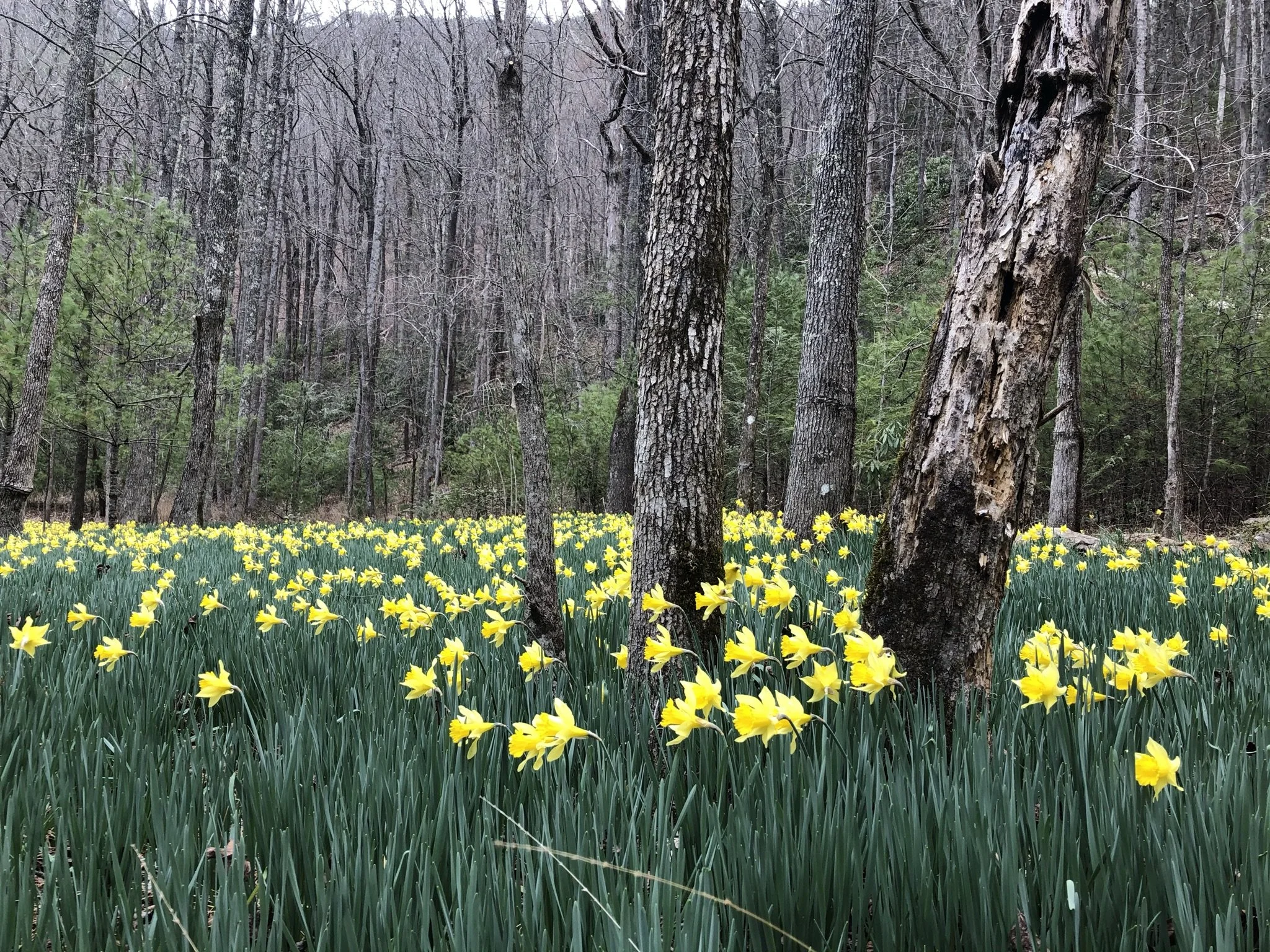
This time of the year, there is a hike I love to take down into the river gorge where daffodils blanket the forest floor. The story goes that a woman, unhappily transplanted to this isolated homestead in the mountains, put a few daffodil bulbs into the ground to try and brighten her days. The homestead is long since flooded and gone, but the daffodils remain, spreading and multiplying through the woods to mark the place she once lived.
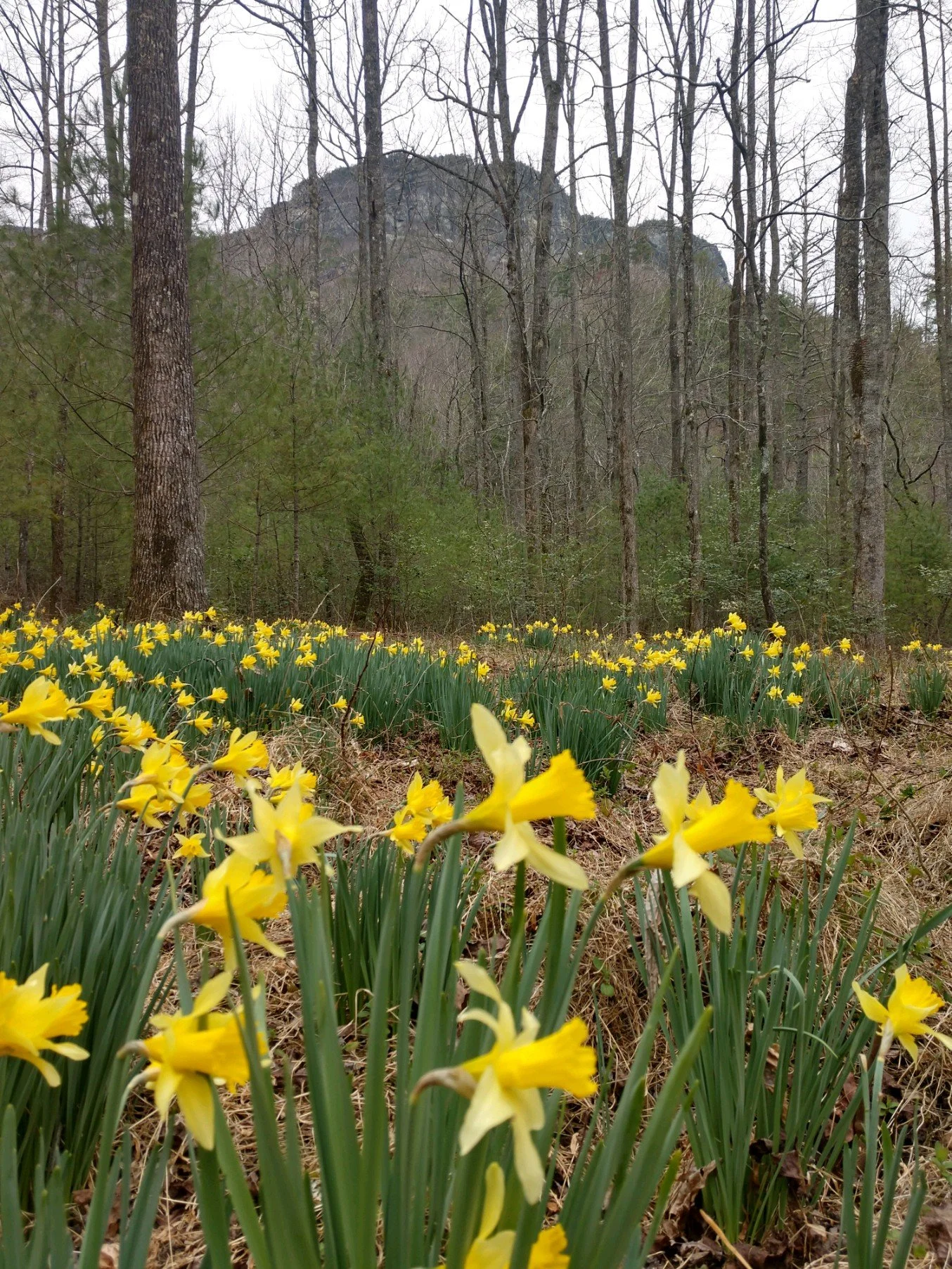
Daffodils form a kind of ghost map, a secret clue to the history of a place. Someone had to plant them, and so wherever there are daffodils there is the story of a person who loved them. Near my home there is a vacant lot. The absence of trees indicates the faint echo of where a driveway once curved, and in the spring blooming daffodils outline what must once have been the entry to the house.
When I studied nettles, I learned that because of their nutritional requirements, they can often be found growing in old homesites where the dwellers had their compost pile. Often once you find a patch of nettles you can walk a radius around them to locate an old chimney or foundation stones. It’s a great way to show off to friends and family (although, it must be said, they are never quite as impressed as one might hope.)

Ghost maps show us what was when we tune into what is. There are botanical ghost maps, weather ghost maps (early morning clouds trace the parts of the earth below that are first to warm), and political ghost maps (I learned in a long-ago anthropology class that the most vehemently misogynistic cultures offer a ghost map of the geographical areas that historically had traditions of female empowerment, because of the retaliatory nature of politics).
How is this relevant to therapy?
Well, the hike up from the daffodils at the river bottom is steep, with persistent elevation gains for three miles straight. You get to witness a parade of coping strategies in those around you and within your own mind, if you pay attention.
When we first discovered this hike, my husband got frustrated with me for hiking ahead and leaving him behind. We could easily have turned this into a full-blown argument, with accusations of selfishness and neediness flying around. But if, instead, we could see the ghost maps—the little girl who absorbed biographies of George Fox and John Woolman, determined to develop grit—the neglected little boy who had to learn to be insistent and vocal to get his needs met—we could navigate the web of relational reality that is so different from what we think of as objective truth.
The past leaves its thumbprint on us. Once we have awoken to a pattern of behavior, we have the thumbprint—the ghost map. It tells us a story about the thumb—the thing that happened in the past that taught us to behave this way.
Our relational models are built in equal part by internalizing what we were exposed to (as James Baldwin observed, “Children have never been very good at listening to their elders, but they have never failed to imitate them”) and reacting against it. So we may find ourselves, inexplicably, lashing out violently in response to a relational trigger one day, and just a few days later responding to the same occurrence by shutting down entirely.
If we can understand the hidden nutrients beneath these nettles, we can treat ourselves with greater compassion and understanding. And we can access more patience when the people we love behave in confusing and irrational ways.

Next time you find yourself confused by your own behavior, or the behavior of someone you love, ask yourself or your loved one these four questions, adapted from the work of Terry Real:
“Who behaved this way when you were growing up?”
“Who acted this behavior out on you?”
“When did you enact this behavior as a child without anyone stopping you?”
“Who hurt you by behaving the opposite of the way you are behaving?”
As humans, we love reasons. In one famous study, participants were split into three groups. One group was told to butt ahead in line without giving a reason. Another was told to give a plausible reason, and a third was told to give an irrational reason. It turned out that although the people waiting in line were angered by the behavior of butting in line without offering an explanation, they were pacified equally by reasons as logical as “I have to go ahead of you because my partner is in labor” and reasons as implausible as “I have to get ahead of you because I had cereal for breakfast.”
If we have a reason for the way we are acting, we can generate more compassion and understanding. This leads to healthier relationships, fewer arguments, and a deeper understanding of our own lives and the lives of those we love.
Noticing ghost maps is a beautiful way to begin tracking and understanding our layered relational realities… the foundation stones below the lines of daffodils.
If you are interested in your own inner worlds and wish to explore the meaning of your dreams, join Lissa and Julie for a daylong dreamwork retreat this September. Click the image below for more information.