Choosing a bigger story
By Lissa Carter, LCMHCS
Recently I replaced a book of poetry that had long held an honored spot on my tiny waiting-room table for an innocuous paperback titled Stop Avoiding Stuff (not an affiliate link— I just genuinely think it’s a useful book).
The reaction was… not overwhelmingly positive. One morning I found the book stuffed under the cushion of the chair. Another time it got placed, face down, beneath a pile of fliers. One client even jokingly told me that she had considered burying it under the paper towels in the restroom wastebasket.
What is it about those three words—stop avoiding stuff— that has the power to provoke such a strong reaction?

Avoidance is the primary strategy by which we sidestep pain, anxiety, fear, panic— all those uncomfortable and unwanted inner feelings —for the low, low, price of not engaging in the tasks and relationships that make us feel that way. There is so much we cannot avoid—the pain of disease or aging, the large and small indignities of participation in a culture that doesn’t always feel sane, the endless tasks linked to survival for ourselves and those we love—that there is a specific kind of delicious pleasure in escaping the things we can.
Reading a novel instead of cleaning the bathroom. Climbing back into bed for another fifteen minutes instead of taking a walk. What’s the harm? Closing the computer instead of finishing the taxes. Pouring a glass of wine instead of practicing the guitar, as you promised yourself you would…
It’s insidious, right? Sometimes the very thing we avoid is the thing we most want to do. Sometimes the experience we cancel, just to sidestep anxiety, embarrassment, or fear, is the very experience that would create meaningful friendships. Or build self-trust. Or allow us to take a stand on what matters.
There is a question hidden beneath experiential avoidance. A question so painful that we’d rather bury it in the restroom wastebasket than allow ourselves to consider it. Here it is:
If you hold the worth of what you are avoiding in one hand--- and the worth of all you are actually choosing to do with your time in the other--which feels weightier?
What are you choosing to do with the minutes and hours of your life?
For many of us, the day is filled with non-negotiables. Work must be done, emails answered, pets and friends and children and partners tended, homes maintained, money earned. And at the tail end of the day, when we have spent most of our precious focus and energy and time, that’s when the soul comes whispering— “you wanted to play the guitar, remember? You wanted to write? You wanted to walk this evening as the sun went down?” And it is to the soul— not to the emails or the bills or the dishes— that we most often reply “not today.”
It’s easy to notice when we avoid doing our taxes. The world comes pounding at the door.
No one comes knocking when you avoid the sunset walk.
Many of you know that my counseling work is deeply informed by story. I would go so far as to say that the mind itself is made of story. Of the six stacked neurons that interpret reality for us, only two take in the raw sensory data from the world. Two draw on old stories--our history, memories, scripts and schemas--to interpret what we are seeing. And two weave it all, raw data and old story alike, into a fluid picture of the world. A story made of the dance between you and the world.
Which means we have far more agency than we may know. To change our story is quite literally to change our experience of the world.
But what does all of this have to do with avoidance?
If the story we are telling about reality is one of fear, and danger, and rejection, we’ll avoid experiences that create discomfort.
If the story we are telling about reality is one of choice, and courage, and participation, we will avoid experiences that keep us small.
Avoidance isn’t the problem. Maybe the title of that book should be: Stop Avoiding The Stuff That When You Avoid It Life Gets Worse Instead of Better For You and Everyone Around You But You Can Keep Avoiding the Stuff That Interferes With You Becoming Your Truest Self.
Catchy.
Lately I have been working with stories from an ancient cycle called the Cath Maige Tuired. When I work intensively with stories in this way, my reality shifts a little. Why? It’s a dance between those neuronal stacks I was talking about earlier and a part of the brain called the reticular activating system (RAS).
The RAS changes the focus of attention depending on the set of stimuli we are currently most attentive to. As the salience of a particular topic rises within your attentional frame, the RAS filters sensory data to highlight that topic. So the more I attend to the Cath Maige Tuired, the more my story-weaving of reality references the themes in that story.
When this happens, the Big Story replaces the stories I generally go to by default— my small stories about the mistakes I’ve made, the anxieties I’m feeling, whether or not that person over there likes me.
When the big story is the one weaving my reality, my avoidance changes. I’m not as worried about my personal anxieties or discomforts.
Where the small story might say: “you’ve worked so hard, you’re tired, you don’t like that sweaty feeling or the pain of sore muscles, you’ll feel anxious if you put off answering that email, go ahead and avoid this walk” the big story says “This world is woven of plants and birds and colors and light, you can avoid answering your emails for a little while and just deal with the anxiety.”
…When the big story is the one weaving my reality, it comes knocking at my door when I avoid the important things. Not the unimportant ones.
At the end of the Cath Maige Tuired the great battle-poet Morrigan speaks of two possible futures. One of milk and mead and spreading forests, one of hunger and war and devastation.
She doesn't say which will happen. They are likely only a story apart.
The story in my mind determines which experiences I avoid. What I avoid shapes my future. I am choosing, every moment, which future I wish to live in.
I’ve been slowly memorizing one of David Whyte's poems I’ve long loved. It starts with this couplet:
Turn sideways into the light, as they say the old ones did
and disappear into the originality of it all.
When David Whyte discusses this poem, he talks about drawing inspiration from a moment in Irish mythology in which the people of craft, a people lessened and diminished by numerous wars, choose to walk away from yet another war. They do so by sidestepping this dimension and entering into another.
In doing so they lose much of what they have fought for over their long years on this land. They lose much of their old shape. But in refusing to participate in a diminishing conversation, they salvage the essence of who they are.
One story might say: by avoiding war they make a terrible mistake. They must take action by fighting for their land.
One story might say: by avoiding a courageous “no”, they make a terrible mistake. They must take action by leaving war behind.
The avoidance of one story becomes the action of another. Two possible futures unfold.
Where the small story whispers “this hurts! throw that book in the wastebasket!” the large story might whisper…”what is the price of avoiding that thing you are avoiding?”
What are you choosing to avoid? Why?
What is the story you walk around with that informs that choice?
Is there a bigger story you’d like to choose? A story about the future you want to live in, a story about the person you want to become, an inspiring vision you hold for the world?
_________________________________________________
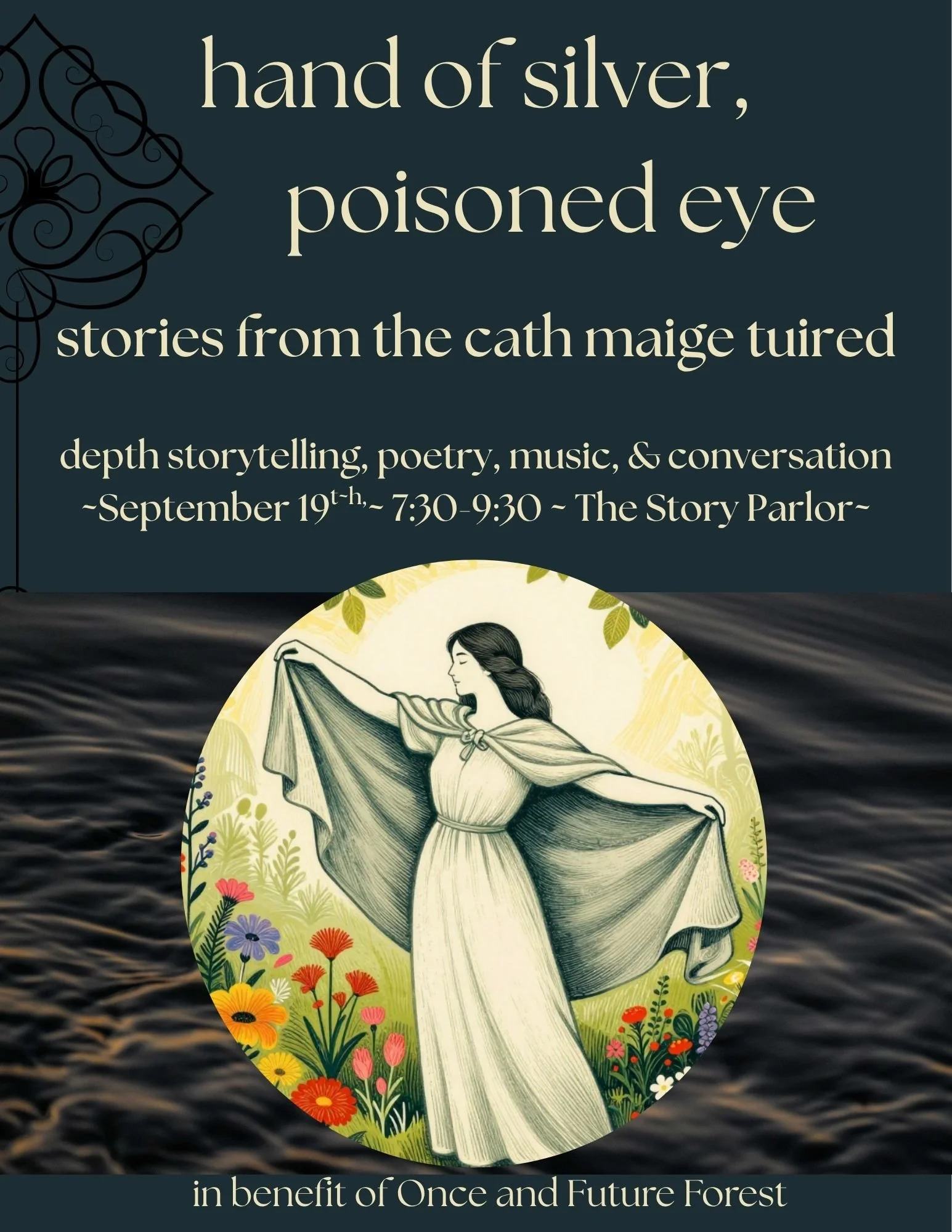
One of my Big Stories these days is the idea of reforesting a swath of Ireland —a wildlife corridor/greenbelt of once and future forest. I’ll be telling stories from the Cath Maige Tuired at the Story Parlor in support of this vision. If you’re in the area this autumnal equinox, please join us!